
Northern Alta (Alexandro Garcia Laguia)
Northern Alta (ISO 639-3:aqn) is an Austronesian language spoken by Negrito communities in northeastern Luzon, Philippines, in Aurora Province (approx. 15.667065, 121.431592). It is used across at least seven settlements and is estimated to have between 50 and 200 speakers, out of an ethnic population of over 1,000. The Northern Alta are descendants of hunter-gatherers traditionally living in the Sierra Madre mountain range. Since the 1970s, most communities have settled among Tagalog-speaking farmers, resulting in intense language contact and, eventually, to very limited intergenerational transmission. The language is clearly endangered, with its youngest fluent speakers aged over 40 years old.
Northern Alta is documented in the ELAR collection “Documentation of Northern Alta, a Philippine Negrito language” (Collection ID 0422), deposited by Alexandro Garcia-Laguia with funding from the Endangered Languages Documentation Programme (ELDP). The open-access collection includes annotated audio and video recordings, wordlists, photographs, a grammar of the language and lexical database, and documents both contemporary practices and narratives of an earlier, more mobile lifestyle.
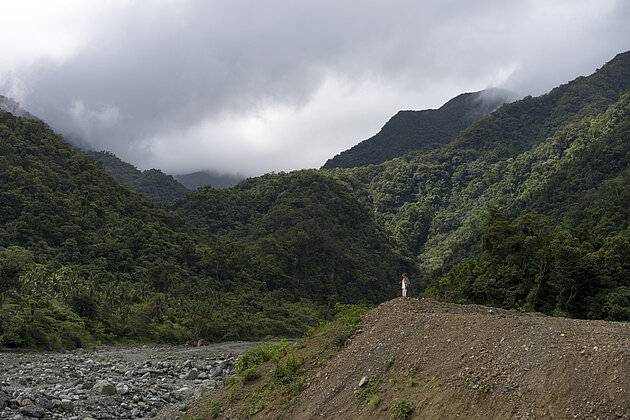
The Northern Alta field sites are located in the Sierra Madre mountain range and adjacent lowland areas of eastern Luzon, along a landscape shaped by steep river valleys descending toward the Pacific coast. Higher areas are characterized by montane rainforest, while lower elevations include dipterocarp forests, rice fields, and coastal zones. The region has distinct dry and rainy seasons, as well as frequent typhoons, flooding, and landslides, all of which shape daily life and patterns of movement. The landscape holds strong cultural significance: many local place names are believed by the Alta to be Alta-language toponyms (e.g. Diteki, Decoliat, Dianed, Ditaylin), and certain areas, such as the sacred Magdalenas, are restricted to Alta community members. The Alta have extensive ethnobotanical knowledge, reflected in a rich lexicon of plant terms tied to forest use.
Traditionally, the Northern Alta practiced a semi-nomadic lifestyle, moving camps two to three times per year while returning periodically to familiar locations. Forced resettlement during the 1970s under Martial Law led to sedentarization and more permanent village life, altering earlier mobility patterns. Modern-day mobility is largely task-based and limited to day trips or several-day excursions for hunting, gathering forest products (such as ferns, rattan, and orchids), and swidden agriculture. Mobility combines walking along forest paths and rivers with travelling by road using motorbikes or tricycles.
Relevant links:
- Northern Alta collection at the ELAR archive: https://www.elararchive.org/dk0422/
- Northern Alta grammar and lexicon: https://www.tdx.cat/bitstream/handle/10803/664081/AXGL_PhD_THESIS.pdf
- Description of Northern Alta spatial language: https://www.degruyterbrill.com/document/doi/10.1515/flin-2022-2027/html?lang=en&srsltid=AfmBOopeNuoD0Xt0xnMeU2CsAutKER2L3EUxiM7qB81bhMTlAim5ktaF