Collaborating communities
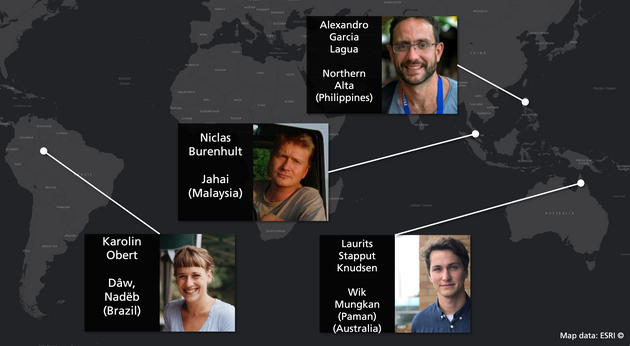
In Walk and Talk, we work with several Indigenous communities whose linguistic, cultural, and ecological diversity provides a robust foundation for comparative research on language use on the move. These communities—ranging from the Dâw and Nadëb of Northwest Amazonia to Wik‑Mungkan speakers of Cape York Peninsula and Northern Alta speakers in the Philippines—represent distinct language families geographical settings, and typological profiles, thereby fulfilling the project’s aim of assembling a maximally diverse language sample. Despite their differences, they share key characteristics central to the project’s comparative agenda: high degrees of daily spatial mobility, often on foot; subsistence strategies grounded at least in part in hunting and gathering; and lifeways embedded in ecologically varied landscapes. Importantly, the project is grounded in long‑term relationships between researchers and community members, built through years of collaborative fieldwork, trust, and reciprocal engagement. These relationships ensure that research outcomes do not remain solely academic but contribute directly to community priorities for linguistic documentation, cultural continuity, and the preservation of endangered knowledge systems. As a result, the project not only advances linguistic theory but also supports communities in strengthening their linguistic heritage and maintaining their connections to the landscapes that anchor their identities.