
Dâw and Nadëb (Karolin Obert)
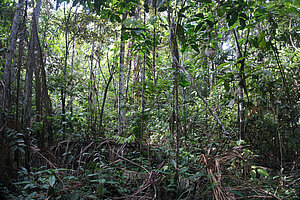
The Dâw and Nadëb are small Indigenous communities of Northwest Amazonia, traditionally oriented toward hunting and gathering. Today, the Dâw number about 140 individuals and live in a single community, Waruá, on the right bank of the Rio Negro opposite São Gabriel da Cachoeira (Amazonas State, Brazil). The Nadëb population is approximately 700, distributed across several communities along the Uneiuxi and Japurá rivers. Both groups speak languages of the Naduhup family, which also includes Hup and Yuhup.
Historically, these peoples were grouped under the label Makú or Makú-Puinave in early ethnographic and linguistic literature—a term with pejorative connotations locally and one that obscured their distinct identities. Past generations lived in small, semi-mobile groups throughout the Negro-Japurá interfluvial region, but centuries of epidemics, slaving expeditions, and extractivist economies drastically reduced their populations and reshaped settlement patterns. Today, while they reside in more permanent communities, mobility remains central to cultural life. Hunting and fishing expeditions often involve extended treks along forest paths and waterways, with temporary camps set up using materials from the surrounding environment—a practice that echoes ancestral lifeways.
The landscapes they inhabit are marked by extensive river networks, flood forests, and elevated terrain within the Amazon rainforest. Rivers such as the Curicuriari, Marié, Téa, and Uneiuxi are not only geographic landmarks but also central to Dâw and Nadëb history and cosmology. These waterways intersect with paths and places referenced in oral narratives about migrations and encounters with other Indigenous and non-Indigenous groups. Dâw and Nadëb oral history reconstruct these movements, shedding light on the deep historical ties between the Dâw and Nadëb and their enduring relationship with the land.
Some existing descriptions of Dâw and Nadëb language and culture include:
Epps, P. Forthcoming. Naduhup. In Patience Epps & Lev Michael (eds.), Handbook of Amazonian languages. Berlin: de Gruyter Mouton.
Koch-Grünberg, T. 1906. Die Makú [The Makú]. Anthropos 1: 877–906.
Martins, S. 2004. Fonologia e gramática Dâw [Phonology and grammar of Dâw]. Amsterdam: LOT.
Obert, K. 2019. The grammar of space in Dâw. PhD Thesis. University of São Paulo: São Paulo.
Obert, K. & Santos, J. 2022. Dâw (Brazil) – Language Contexts”, Language Documentation and Description 22(1): 3.
Pissolati Lopes, N. 2023. Nomes da Transformação: os Nadëb e os outros no alto Uneiuxi. PhD Thesis. Museu Nacional: Rio de Janeiro.
Santos, J. V. 2015. Figuras da mata, ocupantes da cidade e do rio: imaginário etnográfico e etnografia das transformações Dâw – Rio Negro (AM). Curitiba: Universidade Federal do Paraná master’s thesis.
Archival Collections:
Epps, P.; Storto, L. 2013-2015. Documentation of Dâw, a Naduhup language of Brazil. Endangered Languages Archive, SOAS University of London.
Epps, P., K. Obert, and N. Pissolati. 2018+. Nadëb Collection. Archive of the Indigenous Languages of Latin America. https://ailla.utexas.org/collections/1481/.
Epps, P., K. Obert, and L. Storto. 2013+. Dâw Collection. Archive of the Indigenous Languages of Latin America. https://ailla.utexas.org/collections/1501/.
Obert, K. 2022+. Dâw Collection. Lund University Humanities Lab Archive. hdl.handle.net/10050/966d403b-ee5e-4c43-931e-e3e4fa17f77b