
Prosody
Left-edge boundary tones
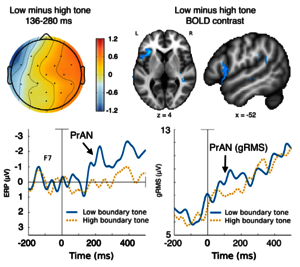
We have discovered a "left-edge boundary tone" (LEBT) occurring in the first prosodic word of Swedish main clauses but not in subordinate clauses (Roll, 2006; cf. Myrberg, 2010). The complementizer att 'that' can introduce both main clauses and subordinate clauses, which would be temporarily ambiguous were it not for the LEBT. The presence or absence of a LEBT can therefore lead to garden path effects. For example, with no LEBT, listeners expect subordinate clause structure. If they instead hear a word order typical of main clauses, they have been lead down the garden path. Using ERP, reanalysis of the unexpected structure is reflected in a P600 effect (Roll, Horne, & Lindgren, 2009; 2011; Roll & Horne, 2011). Upon hearing that a LEBT is missing at the beginning of a clause, listeners strongly activate subordinate clause structure. This gives rise to a PrAN with its most likely sources in Broca's area (Söderström, Horne, Mannfolk, van Westen, & Roll, 2018).
Word accents
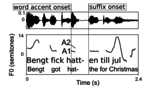
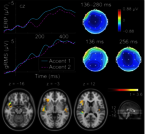
Swedish and Norwegian "word accents" consist of a high or a low tone on a word stem. The stem tone, however, is induced mainly by the word's suffix (Riad, 2014; Rischel, 1963). Thus, the stem hatt 'hat' is pronounced with a low tone (accent 1) in hatt+en 'hat+the,' but the plural suffix -ar induces a high tone (accent 2) onto the stem in hatt+ar 'hat+s.' The same melody change is found in all words with this variation: båten/båtar 'the boat/boats,' bussen/bussar 'the bus/buses' etc. Swedish word accents are often assumed to have low "functional load," since the contrast between word accents is hardly ever used to differentiate between words. However, we have found that, just like left-edge boundary tones that lead listeners to expect a certain sentence structure, word accents lead listeners to expect a particular word structure. Thus, a suffix that has been invalidly cued by the wrong word accent produces a P600, showing that the word structure needs to be reanalyzed (Roll, Horne, & Lindgren, 2010; Roll, Söderström, & Horne, 2013; Roll, 2015; Roll, Söderström, Shtyrov, Mannfolk, Johansson, van Westen, & Horne, 2015; Söderström, Horne, & Roll, 2017; Söderström, Horne, Mannfolk, van Westen, & Roll, 2018). Word accents even produce a pre-activation negativity (PrAN), showing how they pre-activate the ending of words (Roll, 2015; Söderström et al., 2016), possibly originating in Wernicke's and Broca's areas (Roll, et al., 2015; Söderström et al., 2018). We suggest that the main function of word accents might be the predictive rather than the distinctive function. Word accents make processing of their associated suffixes quicker (Söderström, Roll, & Horne, 2012), and a thicker cortex in Wernicke's area speeds up processing of the connection between word accent and suffix (Schremm, Novén, Horne, Söderström, van Westen, & Roll, 2018).